
Don’t Rush Me
Don't Rush Me
The pace I crave isn't possible all the time and yet…
I want to stop and watch the birds soar, wander through a nature park, read a book, write, paint — things that are inherently slow, slow by nature. I want time with my kids to feel like the last two hours of work on a Friday afternoon, when the sun is shining and your friends are already waiting for you on a patio. I want to take my time in a world that is in this perpetual state of urgency — this propulsion to have more, do more, be more.
But wanting slow and living slow are two very different things. I suppose I inherited this urgency from society, as it is relentlessly feeding it to me everywhere I turn. Yeah, let's blame society — that is always a good place to start. But outward blame is always a signal to me to look inward. So I write.
Household of Dichotomy
I often think of my dad when I think about the pace I would like to go. He hates the feeling of being rushed — although he will pace around, inadvertently rushing you if you aren't ready on time. When he has somewhere to go, which is rare because he is a beekeeper and novice goat rancher (is that a thing, a novice goat rancher? well, in his renaissance man era he has made it a thing) he wakes up early. Early enough to have a couple of cups of coffee, read, wander around his property, and then slowly get dressed and head out the door. The pace of a man that has no one to answer to but time.
My mom's approach is a little more complicated. She too doesn't want to be late — so even if she wakes up four hours before it is time to get somewhere, that entire four hours is spent like a squirrel collecting nuts before a cold front. She uses a phrase from her Bicol dialect: Dali-dali na! It means hurry up. Growing up I heard it all day long. She was always in a hurry to do something, go somewhere, finish something. She still is today. And to my great chagrin, I do the same things to my kids when they are just being kids, and I am in a hurry to get adult things done. I suppose I understand her rush a little bit better now.
And on the other side of the spectrum, there is my partner Jarrod. I wrote in my piece last week that he is beautifully, maddeningly laissez-faire when it comes to things outside of his passions — and he is exactly the same way with time. He is that friend you tell you are meeting at 6pm when you are really meeting at 7pm, because you know he will just be getting ready at the designated meeting time.
Households of dichotomy. And then there is me — I want to be on time, I want to take my time, and I don't want to stress about how others treat time. I suppose my beef with time is that I don't have a foothold in it. I suppose we never do.
Painting the Hours
Eight years ago, I got tired of looking at myself in the mirror and pretending that the way I was living was for me. At that point, I had been selling various commercial products and skilled technical professionals for 10 years, spending my income on material things that brought me zero lasting satisfaction. What my soul needed was to see the world. Deep down in my depths lived an artist sitting not so patiently anymore, ready to escape the Pablo Escobar-like prison I had built for her.
When you break free from the umbilical cord of your comfy life, you become an infant of the world. But it is even more complex than that — you aren't fresh, you aren't a blank slate. You are full of everything you didn't choose. You have to actively unlearn everything you thought was true. You have to put yourself out there in the wild, in a new environment, and try to experience things as if for the first time. Observe yourself: how do you react, why do you react that way, where are these feelings and beliefs coming from? You are naked in the world, and your job is to figure out what clothes work for the person you have become.
What I wanted to wear was a painter's smock — my inner self an artist sans artistic skills. I had to approach that dream from the only playbook I had ever seen: grit and hard work. I studied the fastest way to become a professional watercolor painter. I learned that it takes 10,000 hours to be considered an expert at anything. So I started to paint the hours. I copied the best — Frida Kahlo, Diego Rivera, Picasso, Van Gogh, Monet, and any modern artist I found on Instagram that spoke to me. I was learning the skill. I was not becoming an artist.
I started my 10,000 hours in Granada, Spain. We lived in a barrio called Albaicín, an ancient Moorish quarter known for its breathtaking views and steep, winding cobblestone streets. There was no choice but to move slowly. The streets were too narrow, steep, and made of cobblestone — cars, bikes, or anything motorized could not make it through. You walked everywhere in this barrio, and you walked carefully. Carefully up, carefully down. It was a forced slowdown. The universe's way of saying — walk slow and observe.
The building we lived in was built in the 1600s and was so beautifully preserved. The view from my kitchen was the Alhambra, a stunning palace and fortress complex. My surroundings were picturesque, the vibe was artistic, the city was unhurried. The atmosphere couldn't have been more perfect for a budding artist. And still — I felt like a fake. I was even selling my work on the streets. I put down a Moroccan-style tapestry and sat there for hours as tourists trudged up the winding hills, stopping to catch their breath on the slippery stones, pausing to look at my work. I looked the part — baggy cotton boho print pants, leather fanny pack, hair in a braid, sitting next to Jarrod who was busking on his guitar. I looked the part of a vagabond artist. I just didn't feel like one.
I felt like a fraud, I had imposter syndrome — but for good reason. I wasn't an artist. I was a slave to time. I couldn't feel the art — I was logging hours. I was counting completed pieces. I was laying them out on a tapestry as if each piece represented hours logged. I wasn't inside the art, and watercolor was the only teacher that could show me.
What the Water Knows
Picture this — you are staring at a white piece of watercolor paper, thick, textured, blank. Your job is to create an expression on the page. It starts with a light sketch, pencil held loosely across your palm between your thumb and two fingers, sweeping motions, big shapes first, then you start to refine your sketch — all this before even picking up a paintbrush. Then you begin to paint. In watercolor, you go from light to dark. Everything builds on top of everything else. It is a deliberate process that you must embrace — there are no shortcuts, no easy fixes. You have to wait for each section to dry before moving on. Paint next to something wet and the colors run together, which can be beautiful, but if that isn't what you are going for, it can be infuriating. You dance across the page, painting section by section, layering, waiting, thinking, planning, and eventually feeling your way through. It starts to become natural — you just know what your next move is, where the paint and water will mix, which colors work best. It is a feeling that only time can create.
I've been asked before if acetone could replace water to make it dry faster — which tells you everything about how we approach endeavors that require patience. When asked, all I could think of was the acetone taking on the persona of a Pac-Man monster and just eating up the painting they were trying to create. The question felt so destructive in the vein of speed. A teacher of mine, resigned to her students' impatience, suggested we bring hair dryers to class.
When I am painting now, time stands still. I start, I look up, and two hours have passed. I think they call that flow. Which is ironic — because when I was logging hours, two hours felt like an eternity. Logging hours made time feel like it was creeping by, however as I learned to feel my way through, time lost its conceptual hold over me.
One gift that time has given me is a voice. It was just the other day, eight years later, that I discovered the type of artist I am — or at least the artist I am in this moment. I am a human whose art portrays a woman who is both broken and whole, both tamed and wild, both present and longing. Only time could give me that. And only at the pace of watercolors.
Montenegro
Art was teaching me how to be present on the page. Now came the harder lesson — how to translate that into life.
We were living in Montenegro for a month or so when Jarrod met a group of musicians and music producers while playing guitar on the beach in Budva. We were invited to a session at an in-home music studio. One of Jarrod's new friends told us he had a studio in his parents' basement. When you are in Eastern Europe and a guy says to you in a heavy accent that he has a music studio in his parents' basement — and you are an American with no family or connections nearby and you just finished watching the Ted Bundy documentary — going to a stranger's basement sounds like a great idea.
To my great relief, the house was beautiful, and the studio was legit. It had a sound booth for the musicians connected to a mixing room for the producer. There were chairs and a comfortable couch for visitors. That is where I found myself — on a couch sitting next to my love, among talented musicians piecing together art one instrument, one voice, one beat at a time. I was watching something be built from nothing. A song arriving in real time.
I don't know where it enters my body, but it does. It comes in like an intruder and moves around like it owns the place. I have no control — it is as if it has kicked me out. It travels around my body like heat, moving through my veins. I feel it distinctly when it reaches my heart — it starts beating faster and then my breath gets shallow. Not so shallow that it is a panic attack, but shallow enough for my mind to join the race my heart has started running. And it feels like that thing inside my body is trying to jump out, and that feeling makes me want to move — to get up from where I am and move to the next thing, to the next place, to move anywhere from where I am standing in that moment. I think they call that anxiety.
As I was sitting there fighting my anxiety, Jarrod put his hand on mine - that parasite that had overtaken my body froze. Like it felt the warmth from his hand. Like it felt another intruder coming into the body it inhabited. It thought about fighting — I could feel one last surge of survival. But then it died. Right there inside of me. It dropped out of my body.
Once I was alone in my body again, I could really see where I was. I could feel the music, the vibe of the people around me. I could truly understand how special that moment was. And it was beyond the music, the vibe, the people. It felt like a shift was happening right there on that couch. As if when the parasite died, something else was born. This idea that there is nowhere else to be — and how that is true always.
Time is not a currency you can earn more of. It is only something you can try to spend wisely.
The Road Trip
I love going home to Kansas in July. The pace I crave is easier to come by there — almost natural, baked into the lifestyle. This year, my dad flew to Ohio with my nephew to drive us home. Nine hundred miles. Thirteen and a half hours if you like to drive. Three days if you have three young children, a seven-month-old puppy, a teenage nephew, and a Papa Karl who wakes up early enough to have two cups of coffee before anyone else opens their eyes.
I won't lie — I was dreading it. During road trips, I am always on edge, waiting for someone to cry, someone to whine, someone to need the toilet thirty seconds after we had just pulled away from a gas station. It's a constant state of triage.
We were packed into our Tahoe like sardines. My nephew had done some shopping — a teenager let loose in a city with nowhere to shop back home — and his bags had taken over what little trunk space we had. The third row of the Tahoe is always down because all three girls are in car seats, so trunk space is non-existent on a good day. We had his bags, our luggage for a four-week trip, my dad's luggage, a cooler, backpacks stuffed with coloring books, markers, scissors, every crafting material known to man, blankets, pillows, my backpack, my purse — and somehow we managed to cram Bandit into the back amongst all of it. It was tight, but we managed, and off we went.
I stayed tense for the first stretch. Waiting for it all to unravel. And then it did — Ivy had just dozed off, fingers crossed she'd stay down for a couple of hours, when Esme started screaming that her game wasn't working and Aura announced she needed to pee. I was afraid if we stopped Ivy would wake up. I tried to convince Aura to just use a pull-up and we would sort it out after. She couldn't do it. So my dad pulled over and I took her to the side of the road. Ivy woke up. Esme was still screaming. I was trying to get Aura back in the car and I could feel myself rising — the frustration moving up through my body, my voice getting sharp. And my dad said, calm as anything: no need to get excited. Just relax.
A peace rolled over me.
There was no reason to hurry Aura into the car. No reason to get frustrated over Esme's game — we had wi-fi stops ahead, we had time. We had, as my dad put it at some point on that trip, all the time in the world. And he was right. The trip wasn't something to survive. It was a moment to live in.
Three Acres of Heaven
When I look at my kids — six, four, three — I ask myself where did the time go? They aren't little squish babies anymore. They are running around with personalities unmistakably their own. And I am determined to collect every moment of it.
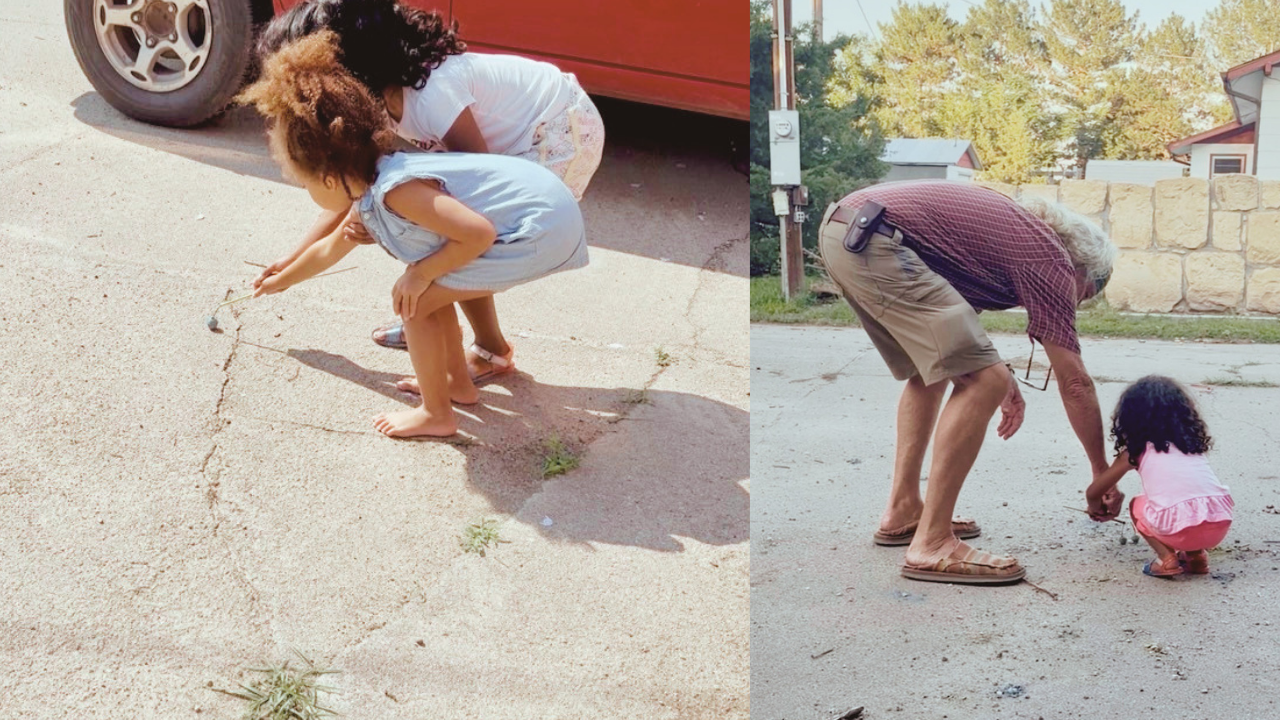
After letting my shoulders fall from my ears and my breath out, we made it to Kansas. Staying in a camper outside my dad's house, spending the month of July in small-town Kansas — on his three acres of little-kid heaven. Swimming in the above-ground pool every day, feeding the goats and chickens, picking fresh vegetables in the garden for dinner, shooting off fireworks with cousins, taking pees outside, looking for toads, decorating the sidewalk with chalk, counting a pool dip as a bath, and playing outside until the sun goes down.
Because the only thing I know about time is that it passes — and when it does, I want to be in it. All in it.
Want to Slow Down?
Rooted — Returning to Rhythm Journal is for the mother who feels rushed, scattered, and out of sync with herself — and wants gentle space to check back in. Not a routine. Not a fix. Just a place to listen to your own pace again.