
The Altar
If you prefer to listen to this essay, you can do so on my YouTube channel
The Morning / The Note
The morning is mine—the only part of the day that is just for me — sacred, quiet, creative. I wake sometimes as early as 4:30 to make that happen.
The night before, I prepare everything — I set out my computer and my journals, fill the kettle with water, set out two jars of coffee grounds, and clean the French press. When the morning arrives, I measure three scoops of decaf and three caffeinated, then carefully pour them in. I get my coffee cup — a special clay tossed mug my dad found at an artisan shop in Colorado — from the dishwasher. I get Jarrod’s tea cup, a large yellow mug with blue and orange hand-painted flowers on it, the kind of cup that belongs in Frida Kahlo’s kitchen. I mix his tea the way he takes it: milk, pepper, turmeric. I pick the kettle up just before it whistles and pour.
I head to my laptop, open it, and begin writing.
It is my ritual. It is the tone of everything that follows.
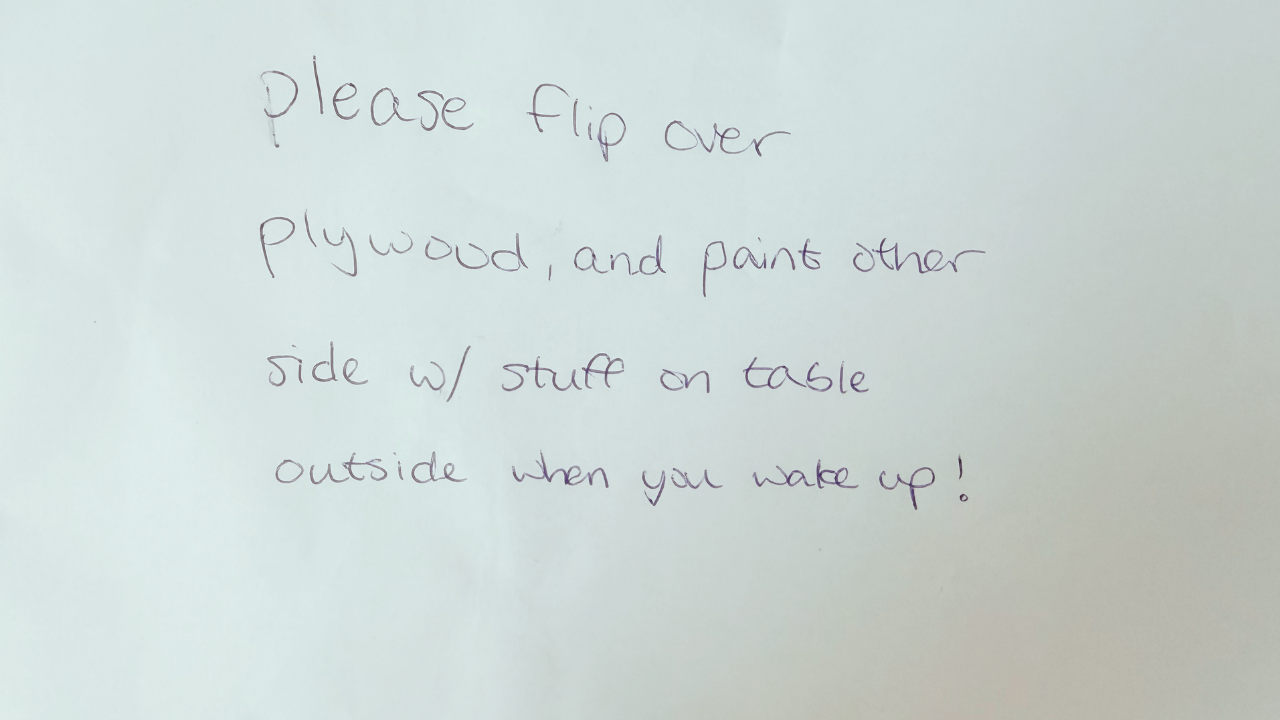
On one particular morning, there was a note on my computer.
Please flip over the plywood and paint the other side with the stuff on the outside table when you wake up!
The Bar
There is a question that changed everything, and it was asked at a bar, by a man on crutches, after a lot of drinks, on a night neither of us wanted to end.
Jarrod and I worked together before we were a couple. I had been married all of two weeks when Jarrod started working at our company — married to someone I knew, somewhere underneath the knowing, I shouldn’t have married. Jarrod and I learned each other slowly. We were something like friends, because on some level I think we both understood that if we got too close it would end badly — for the marriage, for the job, for the careful arrangement I had made of my life.
So we stayed at a careful distance. For as long as we could.
Then one night, after a sales event where we had been drinking the way young people drink at sales events — too much, too easily, because it is what you do and also because we were drowning something neither of us could say out loud — we sat down at a bar. A lot of laughing. A lot of fun. And then he got serious.
He said: What do you want?
I knew exactly what he was doing. I knew what the question meant. And I was not ready to say I had made a life mistake or that I had feelings for him or that I had been pretending not to notice the way a room changed when he walked into it.
So I told the truth sideways.
I said: I want to be in a field. A meadow. Alone. With my dog.
He didn’t say anything. I didn’t say anything. My husband texted, and I went home.
I have thought about that answer a thousand times since. It was not a deflection — or it was, and also it was the most honest thing I could have said. Because what I was describing was the feeling underneath the feeling. The thing I needed before I needed anything else. Space. Openness. Wild. Mine.
I couldn’t come to any of it — to him, to an honest life, to myself — from inside a wrong one. I needed the field first.
The meadow keeps showing up. Just bigger every time.
The Wall
Jarrod decided to build our family a rock wall in the backyard. Not just a simple one for the kids. One for training.
Rock climbing had become something of a religion for him and for our family. We go to the wall at our local rec, walking distance from our house, every Sunday. It started out as an activity to do during the cold winter months and became something more.
Jarrod is meticulous about the things he cares about — hours of research, spec plans, budgets, logistics. He would report each morning how we could make this happen, as if I had sent him downstairs the night before with the assignment. He is a hard worker. He shows up completely for his passions. Outside of them, he is beautifully, maddeningly laissez-faire.
Before the actual build, there was the painting and sealing of the wood. It was spring in Ohio, and we were getting rain almost every day. He watched the weather app by the minute, looking for a window to paint and enough sun to dry. When he saw one he would run upstairs and summon me to help move the slabs of plywood out of the shed. He’d set up the paint and brushes and then ask — do you think you could paint a little? — before heading back to work.
I poured the paint, picked up the roller, and began working as fast as I could. I wanted to prove this was something he could have done himself, between meetings. He would step away from work, come out, and without a word take the roller from my hands and go back over what I had just done — as if I didn’t just do that. In my mind: if you are going to roll over my work, you could have done it yourself. The next coat I still rolled fast, but I made sure to fill in every corner, every crevice, every place the paint hadn’t fully reached. I was not going to give him another humiliating pass at my work.
And then at the end of the night, after reading to the kids, putting them to sleep, and dozing off myself, I would get this nudge. He would wake me to put the boards back in the shed because there was a chance of rain in the night. I would trudge out there in my flip flops and pj’s to help pick up the impossibly heavy boards. The shed has a plywood floor that sits over a perpetual puddle — when we’d step on it, rainwater would seep up through the boards onto my feet, bare from the flip flops, making this unmistakable squishy sound I have now heard approximately forty times.
He would get frustrated when I didn’t move the boards the way he needed — when I’d push or pull too soon, when I couldn’t find my grip.
We got to a point where I had to address the elephant in the room. I took a deep breath, headed downstairs, and walked into his office.
I said: This process is not pleasant. You assume we know what you want and when you want it. You don’t ask. And when you do ask, you don’t ask nicely.
(I sound like my daughters.)
He said: you’re huffy and puffy every time I ask you to do something.
Both things were true.
After that conversation, he was more deliberate about how and when he asked for help. And I helped with minimal groaning.
But the groaning was never really about the boards.
Feeling Small
My mother used to say it to us growing up — I make so many sacrifices that you don’t even know. My brother and I have talked about that as adults, especially now that we have our own children. We used to ask each other — if it was such a burden, why have kids? What was she sacrificing? What dream did she put on hold?
And then it landed, not long ago, standing in my own kitchen, watching myself paint someone else’s plywood.
She didn’t sacrifice a dream. She didn’t give up anything large or singular or nameable. She sacrificed bits of herself. She made herself smaller so it all fit.
I make myself smaller so that it all fits, so it all fits pleasantly.
What is the cost, and when will I pay it?
The Road
I had quit my second sales job out of college. Sales gave me the anxiety of a rabbit living in a fox’s pocket. The only logical next step was another sales job — but before that, a two-week break. I decided to drive home to Kansas, to a town with a population smaller than my apartment building in Dallas.
Before I left, I turned in my work phone. Two hours into the drive, the itch to check it stopped. There was nothing to check. Just road, and my dog and the particular freedom of being expected nowhere.
It was a ten-hour drive through Texas, Oklahoma, and Kansas — flat fields, wildflowers, and tumbleweeds, road on a horizon that never ended. I just drove. Jack in my lap, his warmth and sleeping body a comfort blanket. My thoughts came one after another, like a conscious dream.
I didn’t know it then. That drive was my meadow — the only real, physical time I have ever lived the freedom I crave. Every time since, the meadow has only existed in my mind. That drive, so far, has been the only time I lived in it.
The Dogs
For some reason, there is always a dog at a major threshold in my life.
There was Cookie — a dog I got in college way before I was ready. She was eventually passed between family members, finishing her days with my brother’s family — a lesson in what I couldn’t hold yet.
And then there was Jack, an affenpinscher-poodle mix — grey fur so soft it felt like petting a cloud. Jack came after the twentieth breakup with the same guy. Not an exaggeration. I had been looking at dogs without finding the right one. And then an email arrived: a two-year-old dog, a good home that couldn’t keep him, his picture at the top of the email — he had a smile with an underbite. I met him and took him home the same day.
He never left my side after that. He was afraid of three things: roller skaters, skateboarders, and anything loud — ambulances, police cars, fire trucks. He would bark, chase, and then come straight back to me.
By the time I was sitting on Jarrod's porch, Jack and I had been through a lot together.
One Sunday — we had been officially dating for a few months by then — I was on his porch, hungover, content, in the sun. Jack was beside me. An ambulance came screaming past, and I knew — I knew before I moved — what was going to happen. I lunged for his collar, and he was already gone, sprinting down the sidewalk, and then the ambulance was past, and Jack was not.
Jarrod was running an errand. I called him hysterical. He couldn’t understand me, but he was around the corner. He found me screaming next to Jack’s body. He peeled him from the street and drove me 4.5 hours to my family’s homestead in Kansas so I could bury him there. That was the kind of thing Jarrod did. He asked the right question at the bar, and he drove me home to bury my dog.
I didn’t want another dog for nine years.
And then something shifted — that same overwhelming desire, the kind that arrives rather than builds — and I started looking. Six months later, Bandit.
He was earned. Not found — earned. We walk every day, him and I, in a nature reserve. And when we walk, the thoughts come — and I let them.
The sidekick keeps coming back. So does she.
The Coping Mechanism
For two years, the door to the girls’ room wouldn’t close properly. I blamed the humidity, the doorframe, and Ohio weather. Then one night, after repeatedly trying to slam it shut, it wouldn’t budge. My gaze went to the hinge. The screws were loose. A Phillips screwdriver. Less than a minute. Two years of struggle, fixed.
In every relationship I have been in, I have asserted my independence from the beginning. I think it was an attractive trait to many of my suitors. I would make sure they knew that I was fine before them, would be fine with them, and after them for that matter. I played the cool girl as much as I could. And with the good ones, I would get attached, and then I would panic. Maybe I wouldn’t be okay without them — feelings would get deep, and my self-proclaimed independence would wane. At that point I would unknowingly self-sabotage. Those relationships would end, and as much as I would like to pin it on my mate at the time, it was largely me who drove them into the ground. I always painted a picture of I am fine on my own — an inherited coping mechanism I used to protect myself from heartbreak, which ironically always led to heartbreak of my own doing.
Then I met a man that I would marry. He felt safe — low stakes. I did feel like I would be fine if the relationship ended. I wasn’t afraid of losing him, and for whatever reason I thought that is exactly why it would work. Because every other relationship where I felt that losing them would break me — I found a way to end it first.
What do you want.
What I want is a relationship of high stakes. I want to need someone and be needed. I want to be vulnerable — to love someone so fully that losing them would break me. And when I met Jarrod, he was my high risk and he got me to take it.
When I get into a disagreement with Jarrod, or he leaves a note disrupting my morning ritual, or I am building a wall that I don’t think we need, my mind starts to wander. I start to paint that life alone again. I think about packing up the girls and Bandit in an RV for the summer. On the open road with my girls and my dog, exploring the country, camping under the stars, hiking, living wild and free.
It is baffling to me. I don’t want to do this by myself. I don’t want to raise three girls alone. I don’t want to be alone. I love this man more than I can say with words — more than I could paint on a canvas. Why is this where my mind goes?
So I started writing. And somewhere in the writing, I saw it — my mind working in real time. I am not running from him. I am not running from the life we built. I am trying to escape the emotion. The hinge.
My mind says: things are hard, we need to think about how we’d do this alone. Wild. There it is again. Reason, trying to protect me. Trying to pull me away from what I actually want.
I think about that night at the bar more than I probably should. Not the drinks. The meadow. I think about his question daily now.
What do you want.
It is as simple and as complicated as that.
The Meadow
We all love the rock wall. At least two nights a week we gather around it — taking turns climbing, cheering each other on, lying on the mat, playing fetch with Bandit. Each route is called a problem. Every climber solves it their own way, and we have to see it from their perspective to help. We set goals, conquer routes that once felt impossible, get back up after we fall. There are times we go outside and don’t climb at all. We just sit there together.
That wall is where we gather as a family. It was a labor of love before it was anything else.
Now it is something closer to an altar.
The meadow is mine. She always will be.
Both things are true.
What do you want 🌿
It's worth asking. It's worth sitting with. It's worth writing down.
Rise is a journal designed for exactly that — the quiet, honest work of returning to your own voice.