
Hold Me While You…
If you prefer to listen to this essay, you can do so on my YouTube channel
The Pressure to Cherish It
I am constantly being reminded that this is the best time of my life. That these moments will fly by before I know it. Older women at the park stop and say it as they walk past — cherish this time — it will be gone before you know it. Instagram has posts counting how many summers you have left with your children before they grow up. The homeschool mothers I follow talk about the hours that your kids are actually away from you if you send them to traditional school. There is this constant, unwritten pressure to enjoy this exact moment in time, because it will be gone in the blink of an eye.
And then I start to daydream. When they are in school, how many hours will I actually have to myself to write and to paint? I start doing the math on my time — outside of the family tasks. And then the guilt seeps in — because this is the moment. I won’t have anything to write about — it will be harder to create art if I don’t have this tension, this friction of not being able to get to my blank page. I see that Instagram mom counting down the summers, and I feel a tinge of guilt that sometimes I just want to walk through the library stacks alone instead of going to the summer reading program with my kids.
The Woman in the Mirror
It feels confusing. Time becomes something it wasn’t before. There is a schedule to keep that is bigger than just your own. There are physical beings in front of you growing daily — a living, breathing reminder that time is passing whether you are present for it or not. And then there is the tired face in the mirror. The one that requires so much more thought now — the sleep, the food, all the inputs — because you can see the effect of time on you in a way you couldn’t before. The added weight in places that won’t budge. The dark circles. The tired skin. The dingy clothes. The woman looking back at you is not the same woman who started this, and she never will be again.
Time and the person in the mirror are moving together, whether you are ready or not.
What Tamara Taught Me
My best friend Tamara died in December of 2022. I was devastated when I heard the news, even though we knew it was coming. The end of her long fight with breast cancer. I couldn’t get to the funeral — the weather was bad, I had a two-year-old and a six-month-old, and I had just found out I was pregnant with Ivy, feeling all the nausea of a new pregnancy. Traveling six hours in dicey weather was not in the cards. What that did was allow me to delay my grief. Not good or bad. Just a fact.
It wasn’t until recently that I started to unpack this tremendous loss. As life happens, there are moments I know she would be the only call to make. That I could complain to her and she would hold no judgment. What I didn’t expect was this: so many things I disagreed with her on during her time on earth, I now agree with. Or at the very least, I can see exactly where she was coming from.
And the sad part is I can’t tell her. I can’t call her and say — I get it now.
I ask myself sometimes whether I would have, if she were still here. Would I have called her and told her she was right? I think I would. But I don’t know. Has her physical absence dissolved my ego?
I have had the urge to just call her phone. I know it is shut off. So instead I speak to the air when I am alone and say: I get it. You were right. I’m sorry I couldn’t see it sooner. A lot of it was about raising kids. She was years ahead of me there — her children are grown now. When she was deep in motherhood, I was childless. I disagreed with her then, out loud sometimes, and later to myself.
I just couldn’t see it from where I was standing.
Too Close to See
I am always too close to see what I am actually in. Every day is a negotiation. With my kids — their food, their screen time, where we are going, who hit who and why. And then with myself, all day long. If you fold the laundry now, you will have time to paint tonight. I open the pantry looking for a cookie or some kind of treat and have to direct myself to a 'healthier' sugar — fruit instead. I have to will myself away from my phone and toward the book, the nap, the thing that will actually restore me. It is hard to see anything clearly when your life is a constant negotiation of wills. There is even the negotiation of what to cut out entirely — so that there is less to negotiate.
As I sit here trying to finish this piece, I am actively avoiding a negotiation. Aura is eating toast, Esme is bothering her, and they are both screaming. Ivy is sitting next to me watching them. I am waiting for her to start whining. As I type this sentence, I am suspended in this moment — trying to disappear into the computer while they work out their childhood qualms.
Hold Me While You…
There is something that happens at four years old that I noticed with Esme, my oldest, but couldn’t fully see — because that is the nature of the firstborn. Things just happen, and you survive them. But when the same phase comes around with the second and third child, you start to recognize the shape of it. What I can see now is this: from the womb to around three years old, a child and their mother are inseparable in a way that goes beyond proximity. The baby feels like an extension of your body. And in many ways, she is. But when four arrives, something shifts. They are no longer an extension of you. They are off — forging their own way, building their own world. It is, in the most tender sense of the word, a goodbye.
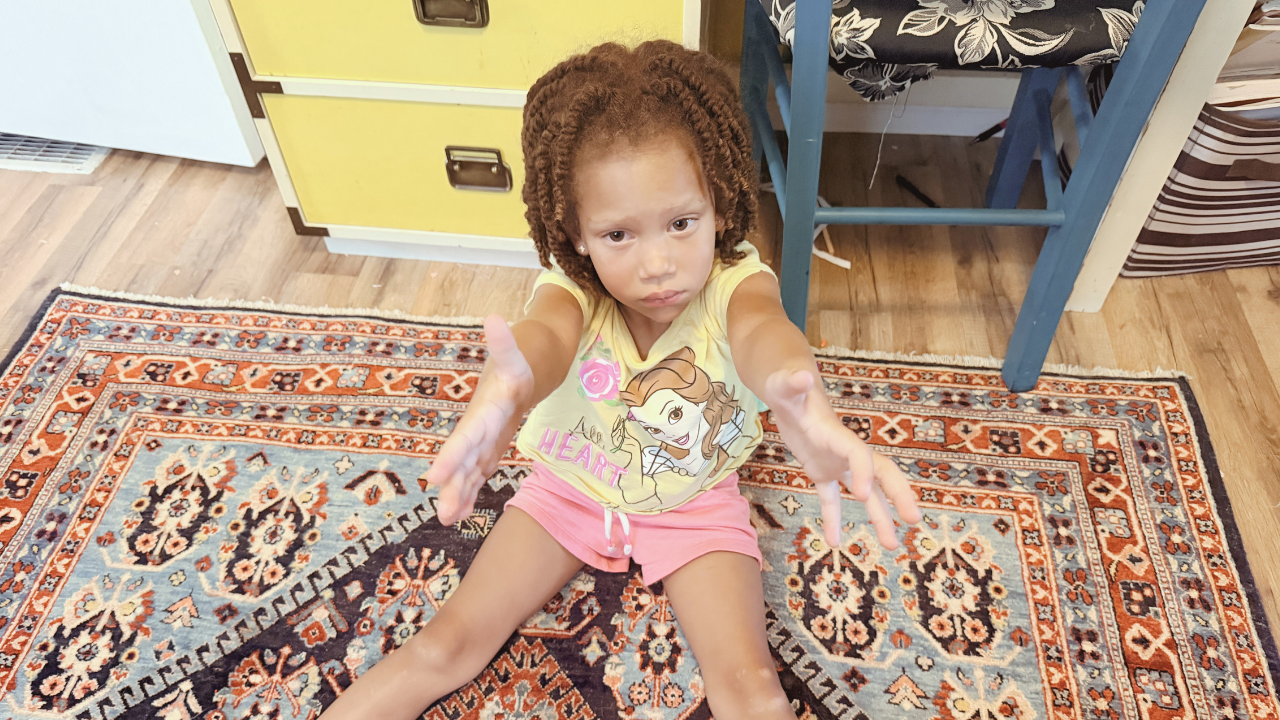
My middle daughter, Aura, is about to turn four this month. Last year she was in what our family now lovingly calls the “hold me while you” phase. Hold me while you use the microwave. Hold me while you fill the water bottle. Hold me while you pee. Hold me while you do the laundry. Hold me while you wash your hands. If I so much as slipped away to the bathroom without announcing it, the meltdown was epic — twenty minutes of crying and screaming that wore everyone in the house down. I couldn’t do anything without holding her. Anything.
The “hold me while” phase became such a household disruptor that I started losing sleep over it. Is this bigger than just wanting to be held? Is she missing something? Does she need something I’m not giving her? Will this grow into something bigger if I don’t address it? I would turn it over and over in my head at night.
What I did was adapt. I don’t know if it was right, wrong, or somewhere in between — but this is what I did. I got proactive. When I was about to fill the water bottles, I would announce it: Aura, I am filling up the water bottles. She would come running, her little arms pumping, hands in fists, and leap into my arms. Same for the microwave. Same for the bathroom — she would drop whatever she was doing and sprint to me, launching herself into my lap. I would laugh so hard. I told her: when you are older, we are going to laugh about this. We are going to talk about the time you had to sit on mommy’s lap while she went pee. She would giggle.
Of course, there were times I just needed to fill the water bottles quickly. So I would run the faucet to drown out the sound of the refrigerator water. Or I would carefully crack the basement door and sneak downstairs to switch the laundry. But if she caught me — if she noticed my absence before I finished — the call would come. Mom, what are you doing? And then: go back downstairs. Do it again. Do the laundry while you are holding me. And she would cry and scream until I would do it again. Hold her and go through the motions of doing the laundry.
It was endearing and unbelievably frustrating in the same breath.
Go Ahead Mommy
Over time, we had started to gently tease Aura about the phase — mostly because if the whole family had to endure it, we figured she could take a little too. We would say hold me while you… and invent some absurd task, and the whole dinner table would laugh, Aura included. She and I would talk about it too, just the two of us. Why do you always do that? What are you feeling when I do something without you? She would state her case. We would continue doing things together.
One day I asked her: Do you feel like you are getting too big for ‘hold me while you’? She just looked at me and went about her business.
That same day I said, Aura, I am going to the bathroom.
She replied: okay mommy, go ahead — I’m playing with Ivy.
I sat down, smiled, and felt a peace roll over me. The relief of doing something that is meant to be private, alone, in the quiet. And then immediately — a sadness. That phase was over.
Two feelings at the same time. That is as close as I have ever come to perspective inside a moment.
The Women Who Came Before
The other day I saw an Instagram reel of a woman my age sitting in bed with her ninety-year-old grandmother and her mother. Three generations. The young mother asked her grandmother: what were the best years of your life? She said: when my husband was in medical training, when my three kids were very little, when money was tight, and I was working my tail off every single day. Then she asked her mother. Same answer. Making the dinners, tending the garden, taking the kids to their activities, keeping the house. Those were the best years. And they were hard.
I looked at the two of them, and I thought: in hindsight, those women can easily pinpoint it. The mother even said she was optimistic that better years were still ahead — but when she really thought about it, those were it. The years where they were using every part of themselves just to stay afloat. Just to keep a family moving forward. They can look back and see the work and the love together, without the daily weight of it pressing down on them. The pain fades. What remains is the shape of what you built.
It is like childbirth. The most excruciating physical pain of my life — three times over. But when I look back on it now, I think about how heroic it felt. That my body could do that. That my mind could move through that much pain and come out the other side. I don’t think about the pain anymore. I remember the relief of the last push. I remember the doctor placing each of my girls on my chest. I think about the instant rush of love that I had never felt before. It is such a practice in instant relief next to insane pain and then eventually a complete disappearance of the pain.
Trusting It
Grief is a pain I can’t shake, but it is a place where I reflect quite easily. I couldn’t see where Tamara was coming from when I was childless — now I need to call her more than anything to get her advice on my own motherhood. I couldn’t see it before, and today it is clear as day.
And now that I can move through my day, doing tasks without holding Aura, I can miss carrying her.
When the day gets hard, I do remind myself: you will look back, and these will be the best days of your life. Stay present. And sometimes that works. And sometimes the day is just too hard to hold that truth. The negotiation is too loud. The mirror is too honest. The guilt is too close.
On those days, I let the day be what it is.
That is enough. That is also the work.
A Gentle Companion for the Hard Days
If this reflection resonated with you, you might enjoy Ease.
Part journal, part gentle guide, Ease was created for the days when life feels heavy, complicated, or simply like too much. Inside you'll find reflective prompts and simple practices designed to help you pause, regulate, and return to yourself.
Because sometimes the work isn't fixing anything.
It's simply meeting yourself where you are.