
The Man at the Bottom of the Escalator
If you prefer to listen to this essay, you can do so on my YouTube channel
“I have to write to discover what I am doing.” — Flannery O’Connor
The Bottom of the Escalator
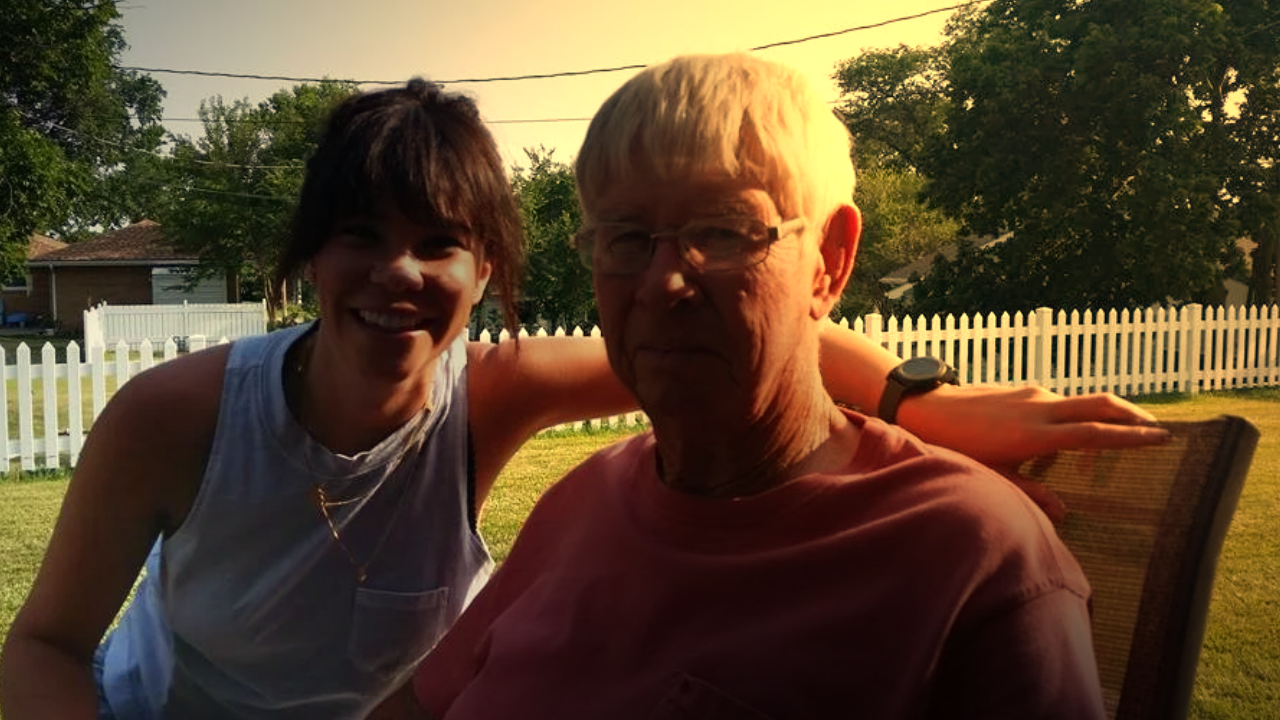
Each year of my young adulthood, I flew to Tucson, Arizona, in early spring. When we would land, I’d open my window to sunshine and desert. I always took a moment with that — the warmth of it, even through the glass — before gathering my things and making the long walk from my gate to baggage claim. At the end of that walk was an escalator. When I descended, there were always butterflies of anticipation, because I knew someone was waiting for me. My grandma likes to wander in airports, so she wasn’t always there. But my grandpa was — standing, watching the escalator. Not distracted, not reading, not on his phone. Just watching and waiting for me.
When I reached the bottom, I would go to him for the same hug — the one he had always given me, my whole life. I would tuck my face into his chest, and we would squeeze each other tight. I would take a deep breath and smell him.
If I close my eyes today and try really hard, sometimes I can recall that smell — or at least that feeling.
Real Connection Is Slow
We gathered in Norton, Kansas — home base for my family — to celebrate the life of my Grandpa Chuck. Cousins, family, friends. All the people still alive that mattered to him, there to pay their respects to a man who had influenced their lives. He was a quiet pillar to each person there.
My grandmother doesn’t like pomp and circumstance. She asked us to just talk about a few memories we had of him, instead of a full-on speech. It wasn’t hard to compile — he had given me a lifetime of them. Tears were streaming down my face the entire time I wrote.
When it was time to deliver the speech, I was nervous, but not the usual public-speaking nervous. I wasn’t nervous about the crowd. I was nervous I would cry too much to say the things I wanted to say. I stood up, walked to the headstone, started to speak, and the tears came immediately. I stopped, said out loud to everyone, “I can do this,” took a deep breath, looked at my dad, and started again. I was able to say everything I wanted to say. I got laughs and gentle nods; I looked into the faces of people who felt what I was saying — who had the same feelings about my grandpa even though they had different experiences with him.
We took our time getting to the luncheon after the funeral. I needed a beat to get myself together before reconnecting with everyone who came. It was all a bit of a blur. I had a one-year-old in tow, but many people came up to comment on my words. It made me feel like my grandpa would have been proud — like he would have been the first one to find me, to tell me he loved what I wrote and said. I suppose I was channeling him through their comments.
A few weeks later, a letter arrived in the mail. A thin white envelope, addressed to me. The return address was my cousin Jordan’s.
The Letter
Jordan is a couple of years younger than me. They say your cousins are your first friends — that’s definitely the case for us. My dad’s sister, Aunt Claire, had four boys. Jordan was the second oldest. He was a picky eater, loud, a night owl. We connected differently as adults. I think we look at the world through a similar lens, one that might be a little different from some of the family. We see each other, or at least I think we do.
He would be the only one in our family to write a letter — outside of our Grandma Bev. So I was delighted when I saw his name on the return address. I found a letter opener on my dad’s desk. I opened it carefully. I pulled the letter out of the envelope and took my time reading it. He talked about how good it had been to connect after a couple of years, and how my speech had him thinking about his own childhood and his connection to our grandpa.
When I finished reading, I took a deep breath and put the letter to my chest. It was as if I had a physical object to represent the connection — to my cousin, and to our grandpa. This love we both had for him, sitting in the words Jordan had written to me.
I had the urge to text him immediately. But I stopped myself. If I sent a text, it would negate everything that letter stood for. The long and enduring relationship we had with our grandpa. The connection we had with each other. The only worthy response was a handwritten letter in return.
I found a piece of notebook paper and started writing. Then I picked up his letter to reference what he had written and realized he had written on stationery paper. My little piece of flimsy notebook paper looked like an insult to what he had sent. I started searching for stationery paper. Who has stationery anymore? I finally found heavy printing paper with some texture to it. This would have to do.
I started the letter again.
I wrote slowly. I wrote slowly because there wasn’t a delete button. I had to look up how to spell words because there was no autocorrect. I had to think about my sentences because there was no squiggly red line to catch a run-on. I had to think about what I wanted to say before I wrote it, because I didn’t want to scribble it out or start over. I had to gather my thoughts. I had to think for myself.
I finished the letter, folded it neatly, and placed it in a long white envelope. I addressed it, put a stamp on it, and drove to the post office, Esme in the backseat. I pulled up to the blue mail drop, rolled down my window, and slid the envelope into the slot. That small motion gave me a flashback to my childhood — my mom handing my little brother and me the envelopes of paid bills to slide into that same blue box. I don’t know if what I felt when I drove away was nostalgia or connection. But it was something.
The Experiment
That was five years ago.
This past summer I started a three-week experiment. I put my iPhone away during the day — still available for calls and texts, but otherwise out of reach. No scrolling, no navigation, no ordering, no reflex reach. I gave myself office hours in the early morning for work, and outside of those hours I tried to get through the day without it. The reason was simple, and I had been avoiding it for a while: my girls absorb everything I do. When I pick up my phone, Esme, Aura, and Ivy want to know what’s in that small screen worth looking at. They ask for games and videos. They reach for devices because they watch me reach for mine. I am modeling the behavior, whether I mean to or not. I wanted to see if I could model something different.
One of my first obstacles in the experiment was navigation. I rely on my iPhone almost entirely to get around in this new city. Because of the experiment, I had to look up directions the old-fashioned way — not a physical map, although that would have been the most old-fashioned way. I went mapquest style, looked up the directions online, printed them out, and studied the route on my laptop. I memorized it.
There was a moment on the way where I wasn’t sure if I had made the correct turn. The urge to grab my phone to confirm was strong. I resisted, kept driving, and then — there it was. The Sharonwood Nature Park sign. The relief and pride that came over me in that moment was something I hadn’t expected. I had reached my destination without a little box telling me where to go. On the way home, because I had actually paid attention, I didn’t need any help at all. Google Maps has quietly taken something — the ability to hold a map in my mind, to know where I am in space, to move through the world with some felt sense of direction. It felt really good to use that part of my brain again. To know where I was going — and to trust that I could get there.
On the fourth day of the experiment, I needed groceries. Without my Kroger app, I couldn’t do curbside pickup, so the girls and I did it old school — two stores, a written list, three little ones in tow. We started at a small fruit and vegetable market. I moved through it deliberately, letting the girls be part of it.
And then something happened that I didn’t plan for.
The cashier asked how I was doing. Instead of the usual surface answer, I told her about the experiment. A mom nearby overheard and joined in. Questions were asked. A real conversation happened — the kind that doesn’t have anywhere else to be. The same thing happened at Trader Joe’s. The cashier asked if I was a millennial, after hearing about the experiment — because we remember life before the iPhone. I think that’s exactly right.
I talked to people that day. Really talked. And it was lovely. Not the navigation, not the groceries — human connection was the biggest thing I took home. The kind that happens when your phone isn’t an option, and you’re just present.
The experiment got me thinking about other conveniences I had stopped questioning. Amazon, for one. I can poke an icon on my phone and in four hours that item appears at my door. What does that do to my brain — and more, to my children’s brains? When things are so instant, and there is so little friction in between, what lessons are we missing? What essential dots are our kids not connecting? What does instant gratification do to their expectations of life?
I don’t have the answers. I’m just noticing the questions.
Heads Down
The questions followed me on my walk that morning.
Because I am running this experiment, I am hypervigilant of others around me on their phones. I was taking my laps when a couple in their sixties or seventies came strolling toward me. They were moving very slowly, both of them with phones in hand, looking down as they meandered through the park. The man was incessantly poking his screen — I thought at first he was frustrated, then realized it was a repetitive tap, like he was playing a game. The woman beside him was constantly swiping up.
When I came around for my next lap, they hadn’t gotten far, maybe thirty yards or so. Behind them was a woman moving a bit faster, but also on her phone, looking down. I passed all three of them and came upon a pregnant woman on a park bench. The sun was shining on her just right; she looked radiant. Her head was tilted down and in her hands was a phone.
The temperature was seventy degrees. The sun was shining. There was a slight breeze, and the birds were chirping.
I’m not sure what was on their phones. I just know my experience that day in that park was very different from theirs.
I am not exempt from this — when I’m in the park with my own kids, I have to think about not getting on my phone. I have to fight the urge to scroll while they’re playing. Sometimes I want to appear to be in the moment. Other times I genuinely know it would be better for me to take it in. The pull of the phone is real. The only thing I have found that is stronger is presence. Real connection. Being here.
Cocktail Hour
My grandparents had a name for that kind of presence. They called it cocktail hour.
They had a drink tray, expensive liquors, mixing tools, and crystal glasses. Their friends would arrive around ten to five, and my grandpa would start mixing at five sharp. My grandma always had special napkins to fit the particular occasion, season, or mood. Everyone would get their drink of choice and head to the patio — a large brick patio with an awning to protect from the hot desert sun, a two-foot brick wall separating their yard from the golf course, and beyond it, the mountains.
What was different about this cocktail hour was that they had a young person to dote over. For a young woman trying to figure out the world, it was so nice to bounce ideas off a generation that had already done it. What struck me most was how well everyone listened. They nodded, smiled, looked at me while I was talking. My grandparents would encourage me to share stories they knew their friends would find interesting. They would set up the conversation — much like an art.
I keep trying to find my way back to something that felt like that.
The (ish)
One of my daily rituals is walking Bandit, our dog, for an hour in the nature park near our house. The path is gravel. There are so many trees that you feel like you are walking through a forest. If you look up, the canopy is so thick that there are stretches of the walk entirely in shade, with rays of light breaking through the holes. It has the feeling of nature — but it is bordered by a busy street. On the other side of the trees, you can hear cars passing, big trucks, the noise of traffic. The closest daily nature I can get is in the middle of everything else. What I would prefer is true wilderness — not a park manicured by man, not one bordered by traffic. But in this season, this is what I have, and I will take it.
On my walk today, I stopped. I closed my eyes. I felt the sun on my skin and heard the wind rustling through the leaves. I willed myself to block out the cars and focus on the sound of the leaves. And I thought — this is the practice. Not perfect nature. Not perfect stillness. Just the reaching toward it, inside the life you actually have.
We can't be absolute in anything. Wouldn't it be easier if it were all or nothing? I think about that with my food, my exercise, my kids' screen time. Wouldn't it be simpler to just cut it all out — to force ourselves to do the right thing? But then you're up against the conveniences, the joys, the pleasures. I always come back to the middle. And I think he lived there too — in the patience of it, the presence of it.
Life is in the middle. Life is in the (ish). And you have to get there slowly. You can't rush through life — and that is the beauty of it.
There are no words to write that will give justice to the feeling of being seen the way my grandfather saw me — and maybe that is the point. The only way I know how to sort out the (ish) is to write my way through it.
If this essay resonated with you — if you felt the pull toward something slower, something more present — the Rooted: Returning to the Senses journal was made for exactly that.
It's a gentle, nature-based journal designed to bring you back to your body through your senses. Not to fix anything. Just to help you remember where you belong.
The same way a gravel path, a canopy of trees, and the sound of wind through leaves can do — when you let them.