
We Eat When We Are Hungry
If you prefer to listen to this essay, you can do so on my YouTube channel
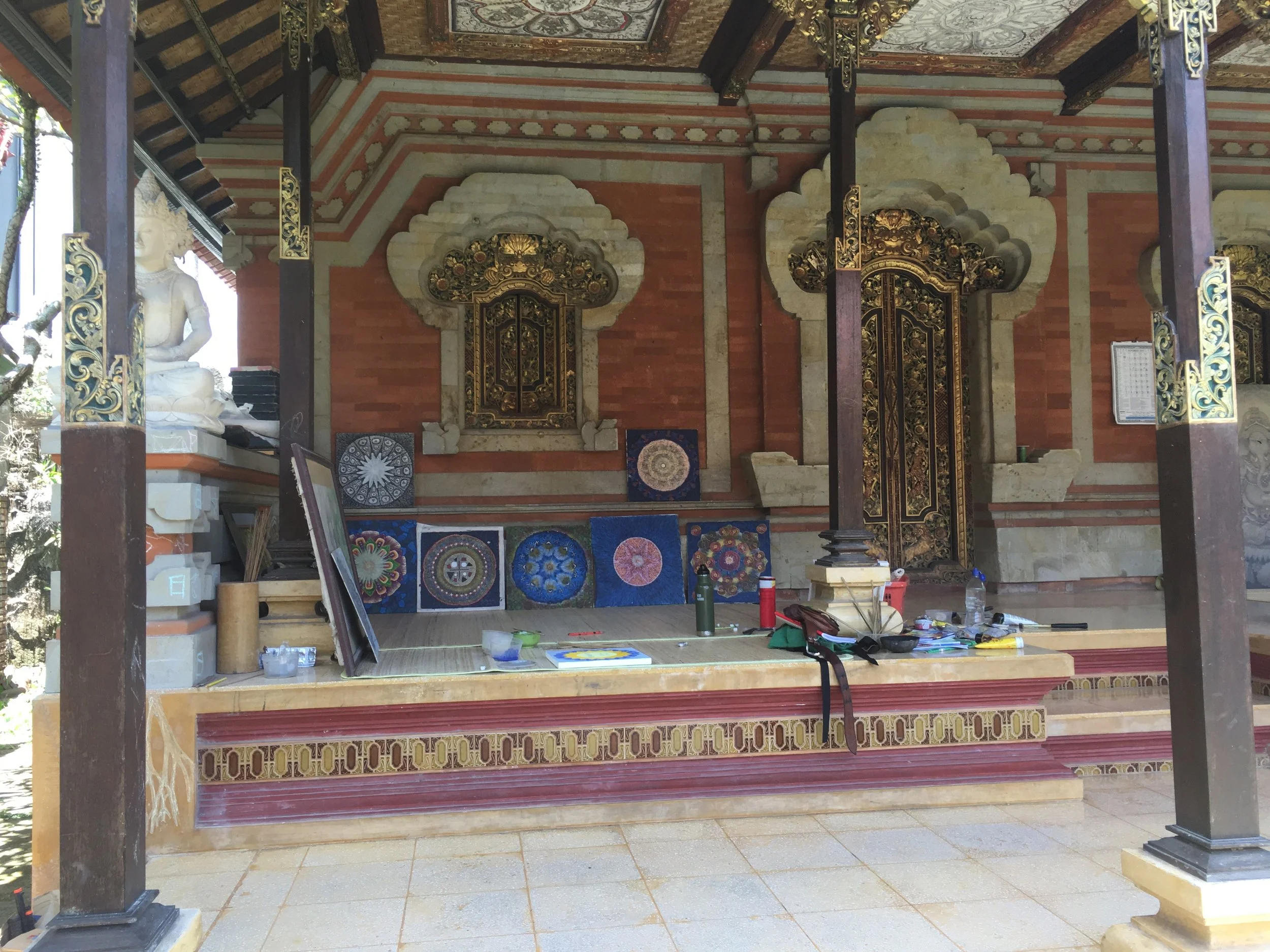
Where I learned to paint mandalas with homemade bamboo brushes. Bali, 2019.
A Room Full of Mandalas
I did everything carefully then, knowing a baby was growing inside me. I walked up the creaky wooden stairs, hands on the walls, each step deliberate. The stairs were worn and grey, cobwebs gathered in the corners. My presence made known by my footprints in the dust.
Not many people ventured up there. That mystery made it more enchanting.
When I turned the corner, I found more than a gallery — hundreds of original paintings, floor to ceiling, stacked and leaning and hanging. As a painter myself, I felt like I had walked into the head of an artist who had long since passed. He wasn’t physically there, but I was having a conversation with him as I moved through his work.
Every painting was a mandala. Vivid colors, layered stories. I would stand in front of each one and rub my belly — some quiet instinct to share what my eyes were taking in. They were leaning against the wall, sometimes ten canvases deep, and I flipped through them like records in an abandoned record store. Dusty, dark, smelling of an attic.
Below, dinner was being made. The smells of fresh Balinese food drifted up — dishes I had never seen or heard of before. It felt like a dream. But I really did ascend to an upper room of lost paintings every night and disappear into them while I waited for my food to arrive.
Every night for four weeks.
That Is Sad
We had landed in Bali eighteen weeks into my first pregnancy — the last leg of a two-year sabbatical abroad. We did what we had done so many times: got our bags, hopped in a cab, and showed the driver the address. He spoke English, he was jovial and talkative, more tour guide than driver, calling out everything we passed and listing everything we had to do during our four weeks there.
In America, Jarrod is an observer — quiet, always minding his own business. Abroad, he became something else entirely. I called him the mayor. It felt like he was campaigning for our residency in each country. Everywhere we went, he was friendly with everyone, alert, aware, and quick to talk to locals. He has an ear for language and would quickly pick up enough to get by. He was delighted by our driver’s enthusiasm.
That was how we traveled. Nothing touristy or fancy. We stayed where locals lived, adopted local behavior as quickly as we could, always with the intention of blending in. So it was natural for the conversation to turn toward the day-to-day of a Balinese family.
As we passed a market, our driver pointed it out. Mothers, he told us, would arrive around 4 am for the freshest produce, go home, and prepare the meals for the day. The family would eat what was prepared in the morning throughout the day, as they got hungry.
I said: They don’t all sit down together for dinner?
He said: No. They eat when they are hungry.
I looked at Jarrod. That’s sad, I said. They don’t have that together time at the dinner table?
The driver didn’t hear me. Jarrod gave me a shrug with a slight tilt of his head. I knew what he meant.
The Compound
The driver dropped us off at the front. We walked through an entrance with a small desk that looked as if it had never been occupied and wandered toward the middle of the compound.
At the center was an open pavilion — a bale, in Balinese — ceiling fans turning, tables beneath it. This was the restaurant, a home-cooking operation, everything vegetarian, $1.60 a plate. Around it stood several small dark wooden bungalows, one for each family. Next to the dining area a Buddha statue held its place, incense always burning, fresh flowers draped around it, small offerings placed at its base.
We had landed exactly where our cab driver had just described.
Dinner was the only meal they served, so evenings were when we settled in to watch. But during the hot afternoons, cooling off by the pool, we observed too — women cooking, children running from bungalow to bungalow, men fixing whatever needed mending. An extended family moving through their days in full view. Together, not because they had scheduled it, but because they lived inside the same rhythm.
Jarrod bought me a painting lesson with the son of the famous artist. We made our own brushes from bamboo sticks, fraying the ends into bristles, and painted mandalas the same way the grandfather had. Homemade tools from the resources around them. We worked with only a few colors. It transformed the way I painted — simpler process, more deliberate details. I wasn’t just watching this family’s way of life anymore. For a moment, I was living a small piece of it.
I had looked at Jarrod in that cab and said That’s sad. Four weeks later, I understood that I had it exactly backwards. They didn’t need a dinner table to be together. They were together all day long, in every form — working, creating, repairing, raising children, preparing food. The togetherness wasn’t saved for one hour in the evening. It was the whole day.
And when their bodies told them they were hungry, they ate.
The idea that I thought it was sad came from my own upbringing, of course — the traditions my parents so lovingly poured into us.
Lola Is Here
My mother comes from the Philippines every summer and stays for months at a time. There is the saying that it takes a village to raise children, and that feels so true. When my mom is with us, it feels like I have my own village. She tags me on everything — I make dinner, she cleans up behind me. I do the laundry, and she has it folded before I get to it. I vacuum, she sweeps. I need an hour of work. She is in the backyard, sunbathing with the girls, just like she and I used to when I was little. Having Lola here is a gift I don’t take lightly.
We had reached the end of a long week. The only groceries left were for a meal I had been putting off — a new recipe with a special sauce, lots of chopping and blending, many steps, lots of dishes. I turned on a podcast, the girls went outside with Bandit, our dog, my mom was napping, and Jarrod was wrapping up work. The meal came together pleasantly despite my resistance.
When I was done, I called everyone to the table.
Jarrod was full from a late lunch but came up to sit. Aura and Ivy came running in from outside. Esme was mid-drawing, full from a snack, hesitant about a new meal — she stayed in the living room. I plated dinner for Aura, Ivy, my mom, and myself. Jarrod sat with us, no plate. Esme stayed with her masterpiece. The four of us settled in.
This scenario had played out before during my mother’s visits. That evening, she was ready to talk about it.
Before we sat down, my mom called across the room. Esme, it’s time to eat. Esme said no thanks. My mom tried again. Your mom worked so hard on this meal. Come on. Esme was content where she was.
My mom sat down. She took a bite and immediately commented on the taste — she loved it, or at least wanted me to feel good about the work it took. She turned to Ivy and Aura. It’s yummy, isn’t it — in her language, of course. They nodded and repeated after her, learning Tagalog at the dinner table.
As the laughter settled, I almost felt it coming.
“Hanna, when you were growing up, we all sat at the table together, every dinner, no matter what. Your father wanted us all there. No TV, no toys. Just us and our food.”
I nodded and added to the memory.
“Poor Charlie talked all through dinner and never ate a bite. Dad made him sit there by himself until he finished.”
She laughed. Yes! He did. I remember that. It was very important, she said, for all of us to sit together.
I smiled. I looked at my girls. I continued eating.
We Eat When We Are Hungry
Yesterday was a good day. A day at home after a full week, nowhere to go and not too much to do. The girls wove their play inside and outside. Grandma and Grandpa visited. Dare I say it was a relaxing day?
My stomach started rumbling around 4 pm. Esme was deep into a TV series, cutting and coloring her creations. Ivy and Aura were both napping. Jarrod was downstairs finishing his movie. I put on a podcast and started cooking. Uninterrupted cooking to a podcast has quietly become one of my favorite things.
When dinner was done, Jarrod came upstairs. Grab your climbing shoes, he said, it’s nice out, let’s go climb. He built us a 13-foot climbing wall in the backyard — 20 degree angle, the whole thing. Before I could answer, Aura woke up from her nap on the couch, from hearing her dad say climbing. Are we climbing? she said, still half asleep. I asked if she wanted dinner first. She said climb now, dinner later. She is three years old and obsessed with rock climbing like her daddy. They headed outside. Esme stayed with her drawings. Ivy was still asleep.
So I ate the hot meal I had made by myself. It was warm and quiet and exactly what I needed.
After I ate, Ivy woke up hungry. She ate right away. Two dinners down.
We all headed outside. Jarrod and I climbed while the girls disappeared into their imaginary world. Bandit ran the perimeter of the yard. Then he stopped, ears up, and bolted toward the back gate. It swung open — four cousins. The girls screamed. All seven of them just started playing, wild and loud and completely alive.
The light faded. The air had that feeling. The day was done.
Rain was coming, so we covered the wall and mats with tarps. The kids picked up the outdoor toys. Hugs, kisses, cousins gone. We headed inside.
I plated dinner for Aura. Whipped up pesto pasta for Esme — one of the three meals she will eat. Got Jarrod’s plate ready for after his shower. Everyone devoured their food. They were hungry from a long day, and every plate came back clean.
Everyone was nourished.
At the Sink
After everyone was fed, off to showers they went. I found myself in a familiar place — the kitchen sink, hands in warm water, gazing at the stars through the window above it.
My mind drifted back to Bali. That dusty room. The mandalas. The cab driver. The way they moved through their days in rhythm, together, without needing a designated hour to prove it. And then to my mom. I think even after a day like this one she would be very happy with the way this family was nourished.
I thought about how, in busier seasons, a set time around the table matters. But in this season — when we can eat when we are hungry, when cousins walk through the back gate unannounced, when togetherness finds us rather than the other way around — I can smile at a day well lived.